
Human-Level Intelligence vs. Artificial Intelligence
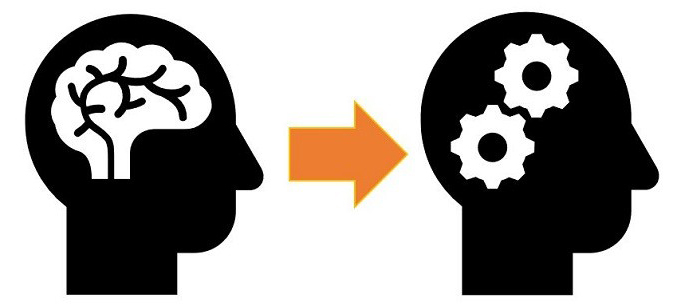
The human brain produces a form of natural intelligence that is totally different than the intelligence that is generated artificially. Natural intelligence is created by a biological algorithm, where artificial intelligence is formed with a mathematical algorithm. The major differences between human intelligence and artificial intelligence are:

Energy Efficiency
All of human intelligence is produced using at most 20 watts of power. The brain has a highly efficient subconscious process that separates what it knows from what it doesn’t know. The brain identifies the unknowns so it can dedicate its energy usage. The brain prefers a perfect world and is therefore only concerned with that which is out of place. This is the reason why when a person walks into a familiar room and a chair has been moved; their brain immediately identifies that change. When everything is perfect, the brain can perform daily tasks in a fully automated fashion with the least energy requirements. By identifying the unknowns, the subconscious process achieves tremendous energy savings because 99.99% of the sensory data does not require processing. The brain’s limited processing capabilities is then able to concentrate its resources resolving the unknowns to restore the perfect world’s rhythm.
Artificial Intelligence was never designed to be energy efficient. In fact, its capability is measured by how many data points it can calculate and the amount of electricity it consumes. Artificial intelligence requires a never-ending electrical supply to mimic even the smallest degree of human intelligence. For instance, ChatGPT running in a data center is the equivalent to powering 33,000 households. Elon Musk’s xAI requires 140 million watts of power to create a single artificial intelligence. The equivalent power of 7 million human brains. On top of the energy requirements, artificial intelligence requires an enormous amount of water to cool their related data centers. These clusters can consume up to 5 million gallons a water per day. Artificial intelligence is a brute force mathematical method for estimating human intelligence.
Self-Awareness
Humans have the ability to understand the world and themselves. The brain performs a rhythmic, periodic measurement of the space around us which creates sensory awareness of the world. This combines with a human’s ability to determine how that world affects their body to create self-awareness. Self-awareness maintains two perspectives of a person’s existence, private and public. By joining sensory awareness with self-awareness, humans understand their own physical existence in the world’s timeline, how it affects us, and how we can affect it. That timeline establishes a continuity that stretches from a person’s past into the present into the future. By understanding the timeline, humans can exist and thrive in a cause-effect universe.
Artificial Intelligence has no greater understanding of the world or itself. While it can produce a rudimentary form of sensory awareness, it is not grounding in either its own existence or in the world’s timeline. As a result, artificial intelligence routinely makes completely arbitrary decisions with no basis in reality. The industry calls these decision failures hallucinations. Hallucinations are caused by misinterpreting reality and since artificial intelligence doesn’t have self-awareness, it’s not grounded in reality and will never possess real-world understanding.
Cause-Effect Reasoning
Human Intelligence is a produced in a cause-effect universe. Humans, like all lifeforms, categorize all experience based on cause and effect. For example, a child sees a hot stove and presses their finger against the burner and they then feel pain. With this single lesson, the child will never touch the stove again. Cause-effect reasoning is understanding that actions have consequences, where a specific action (cause) leads to a specific outcome (effect). Humans learn by constantly experimenting with cause and effect in an attempt to maximize rewards and avoid punishments. It is this simple positive-negative conditioning technique based on pairing data patterns moment-to-moment that creates all of human intelligence.
Artificial intelligence, in comparison, is based on mathematical calculations where probability, statistics, and regression analysis generate an approximation of intelligence. Math is great at finding the obvious, but fails miserably at identifying the many subtleties’ necessary to make good decisions and adapt quickly to a changing environment. Consider driving a car. An artificial intelligence trains for six months using a million hours of experience to function at even a basic level. A human teenager learns to drive that same car in about 20 hours. The artificial intelligence needs the million hours to calculate every possible outcome, where a human only needs a basic understanding of the task and can adapt to generate unlimited outcomes.

Meaningfulness
Every element of human intelligence means something which is to say that it possesses serious, important, or useful qualities or purpose. Humans use emotions to generate a set of feelings that can be assigned to the many elements in their lives. These feelings create meaningfulness and allow humans to incorporate many subtleties and nuances that establish a person’s relationships with the world. Consider a child in the road that may be killed by a speeding car. The mathematical decision is to not risk life to save the child because to do so would dramatically increase your probability of injury or death. The human decision is not so black and white and contains a multitude of emotions and feelings attached to that child. These states contain both positive and negative emotions and are framed according to a person’s ethical and moral beliefs. So, a human can empathize with the child, understand the true importance of the child, and will risk themselves to save the child.
Artificial intelligence has no understanding of real-world meaning. One of the central problems is that all the data is converted to a mathematical representation to perform a calculation. Its mathematics are completely impersonal. Artificial intelligence has no feelings about anything. It wouldn’t care if it saved a child or saved a banana. It is all the same thing to artificial intelligence. Consider virtual assistants such as Alexa or Siri. Both programs calculate a probable outcome and deliver it using human language. It may sound human, but it is actually a cold calculating computer that has no feelings, whatsoever. Since a user cannot be assigned emotional relationships, the artificial intelligence wouldn’t care if it told a user to jump off a bridge, jump out of a plane, or jump in the bed. Without meaning, what’s the difference.
This is why we created Human Artificial Learning (HAL)