
Products
Signal Edge's Neuro-Symbolic AI Product
It's Humanized AITM offering Human-Level Adaptability and Task Automation
It's Quick Thinking AITM offering Real-time Awareness
Consists of three different components:
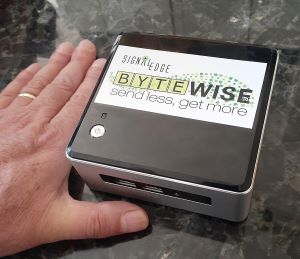
ByteWiseIoT Teleporter
Signal Edge's ByteWiseIoT Teleporter creates real-time data by eliminating 99.9% of its size through our patented process.
Artificial Subconscious IntelligenceTM (ASI)
Coverts the real-time data to thoughts. Thoughts are composed of symbolic images and are used to generate awareness.
Cognitive Object Interface (COI)
The COI allows users to tap into the thoughts to produce full comprehension of the situation. As the COI is used to react, the Neuro-Symbolic AI is trained. This produces the AI intelligence needed to perform analytics and automation. As the AI learns an organization's tribal knowledge it becomes humanized, being capable of cognization. A Nurse during operations, for instance, can use the COI to force multiply their own capabilities and talents.
Neuro-Symbolic AI is not a Language Model; it doesn’t talk, it thinks. Our Quick Thinking/Humanized AI generates differentiators that uniquely separate our solutions from the rest of the marketplace. We go where they cannot.
See The BYTEWISEIoT Demonstration
Data Teleportation
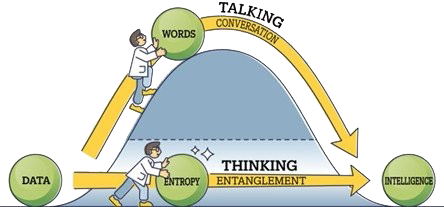
Data Teleportation is the theoretical instant transfer of information between two devices that are entangled. Resent research into the human intelligence process has shown that the brain is a quantum process that uses teleportation to optimize dataflow. The brain uses neurons, not quantum particles, to form an artificial entanglement to translate the enormous amount of sensory data into intelligence.
Neuro-Symbolic Intelligence
Neuro-Symbol Intelligence is a memory and general processing framework for storing, searching, and matching human experience. Neuro-Symbolic Intelligence represents raw sensory data as a combination of neurological states and symbolic images. Symbols and images provide a means to generalized knowledge allowing entire concepts to be understood with a minimum set of memory encodings. Emotions serve to modulate the data allowing for different interpretations of the same data and allows data to be prioritized.
Humanized AI

Humanized AI is the final technology needed to implement human-level artificial intelligence introducing human elements into the decision-making and learning process. Humans make decisions and learn very differently than current artificial intelligence. Artificial intelligence is about mathematics and probability assessment. While this is great for mimicking known repetitive tasks, it lacks the ability to continuously learn and adapt to new situations.